Decision Paralysis: When Every Choice Feels Like a Trap
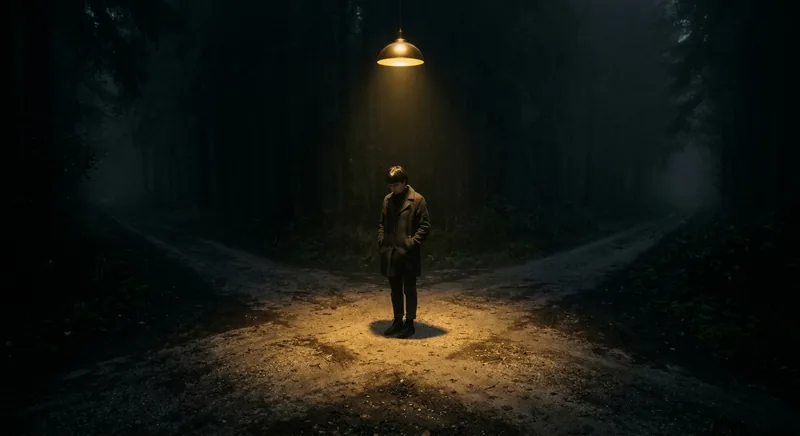
You have been staring at the two options for forty-five minutes. Or forty-five days. The information is clear. The pros and cons are mapped. You know what the rational choice is. And you cannot pull the trigger. Something seizes at the moment of commitment — a cold flood of dread that turns every option into a trap and every choice into an irreversible catastrophe.
Decision paralysis is not indecisiveness. It is not a personality flaw or a lack of information. It is a pathological neural network that encodes the act of choosing as a mortal risk — because choosing means closing a door, and the network treats every closed door as a loss you cannot recover from.
The Fear at the Root: Irreversibility as Threat
Research on the fear primacy hypothesis[1] proposes that fear is the foundational emotion from which secondary emotional states derive. In decision paralysis, the foundational fear is the fear of irreversible consequences — the terror that choosing wrong will produce damage that cannot be undone.
The amygdala[2] does not process probability. It processes magnitude. When the neural network fires at the moment of decision, it does not calculate that the probability of catastrophe from choosing Restaurant A over Restaurant B is negligible. It fires the same alarm for a dinner reservation as it does for a career change — because the network responds to the structure of the situation (an irreversible commitment) rather than the content (what the commitment is about).
This is why decision paralysis often affects low-stakes choices as intensely as high-stakes ones. The person who agonizes for weeks over which laptop to buy is experiencing the same neural mechanism as the person who cannot choose between two job offers. The network does not care about the stakes. It cares about the structure: choosing = closing a door = loss = danger[3].
Structural insight: Decision paralysis is not about the decision. It is about a neural network that encodes the act of choosing itself as dangerous. The content of the options is irrelevant. The network fires at the structure of commitment — the moment when possibilities collapse into a single, irreversible reality. This is why more information makes it worse: more options means more doors that choosing will close.
The Paradox of Optionality
Modern life amplifies decision paralysis because it offers unprecedented optionality. More choices means more doors, more potential losses from choosing, and more fuel for the fear network. The person in decision paralysis does not need fewer options. They need a nervous system that does not treat choosing as catastrophic.
The pursuit of the “optimal” choice is itself a fear-management strategy: if I can find the perfect option, no doors need to close because the chosen path will contain everything the unchosen paths offered. This is the perfectionism-paralysis connection — the neural network drives the person toward an impossible standard (the choice that loses nothing) because any real choice triggers the loss alarm.
Why Research Makes It Worse
The intuitive response to decision paralysis is more information: more reviews, more comparisons, more opinions, more data. But research consistently shows that additional information increases the sense of potential loss (each new data point reveals another dimension on which the unchosen option might have been better) and prolongs the agony without changing the structural problem: the act of choosing still triggers the fear network.
Research on prefrontal cortex function[4] has documented that decision-making capacity is impaired by chronic stress and emotional load. The person in decision paralysis is making decisions with a brain already depleted by the sustained fear response the decision itself produces. The longer the paralysis continues, the worse the decision-making capacity becomes — creating a degenerative cycle where the inability to decide erodes the very cognitive resources needed to decide.
Decision Paralysis as Avoidance
Not deciding is itself a decision — a decision to avoid the fear that choosing produces. The paralyzed person is not failing to act. They are successfully avoiding the moment of commitment that their neural network codes as dangerous. The cost of this avoidance (missed opportunities, stalled careers, relationship stagnation, the agony of prolonged indecision) is paid in slow installments rather than the acute terror of choosing.
This is structurally identical to all fear-based avoidance: the person sacrifices long-term outcomes to manage short-term fear. The pattern is the same whether the avoided trigger is a shopping mall (agoraphobia), a phone call (phone anxiety), or a decision (decision paralysis).
The Structural Approach
The Efremov Method® approaches decision paralysis by targeting the neural network that generates the fear response at the moment of commitment. When the network’s charge is collapsed, choosing stops producing an alarm signal. The person can evaluate options with the full capacity of their prefrontal cortex[4] — uncorrupted by a fear cascade — and make the choice based on rational assessment rather than terror avoidance.
The result is not recklessness. It is the ability to choose and move forward without the agonizing dread that previously made every commitment feel like stepping off a cliff. Doors close, as they must. The nervous system does not treat this as catastrophe. It treats it as life.
Frequently Asked Questions
References
- Andrei Efremov (2025). The Fear Primacy Hypothesis in the Structure of Emotional States: A Systematic Literature Review. Psychological Reports. DOI ↗↩
- Joseph E. LeDoux (2014). Coming to terms with fear. Proceedings of the National Academy of Sciences. DOI ↗↩
- Dean Mobbs, Ralph Adolphs, Michael S. Fanselow, et al. (2019). Viewpoints: Approaches to defining and investigating fear. Nature Neuroscience. DOI ↗↩
- Wen Li, Andreas Keil (2023). Sensing fear: fast and precise threat evaluation in human sensory cortex. Trends in Cognitive Sciences. DOI ↗↩1↩2
Ready to see if this applies to your situation?
Work With Me →