Nightmares and Night Terrors in Adults: What Your Brain Does While You Sleep
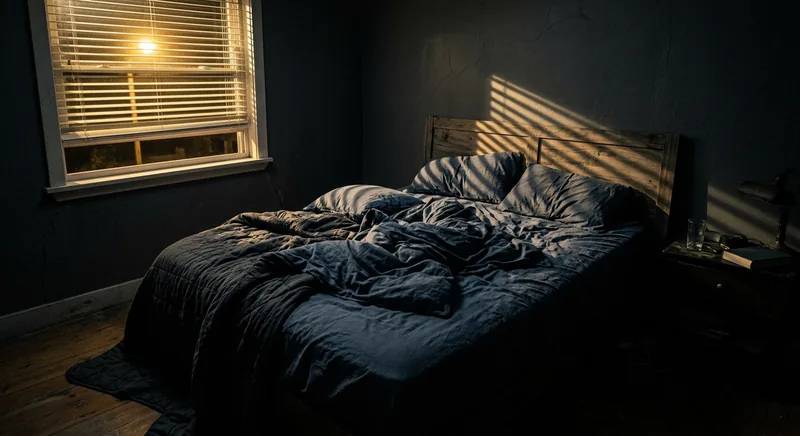
You wake at 3 AM drenched in sweat, heart pounding, disoriented by a terror so vivid your body cannot distinguish it from reality. The content may be specific — a pursuer, a fall, a scene from a past trauma — or formless: a crushing dread with no image attached, just the raw physiological signature of mortal fear.
Nightmares in adults are not “bad dreams.” They are pathological neural networks activating during sleep, when the prefrontal cortex’s suppressive capacity is at its lowest and the deepest fear memories surface without the filters that manage them during waking hours.
Why Fear Networks Activate During Sleep
During REM sleep, the prefrontal cortex — the brain’s executive control center, responsible for rational evaluation, emotional regulation, and impulse suppression — is functionally deactivated[1]. Simultaneously, the amygdala and limbic system become more active than during waking states[2]. This creates a specific neurological condition: the fear generator is running at full power while the system that normally regulates it is offline.
This is why nightmares feel more intense than waking anxiety. During the day, the prefrontal cortex dampens the fear network’s output, producing managed anxiety. During sleep, the same network fires without dampening, producing raw, unfiltered terror. The fear you experience at 3 AM is the fear that was always there — you are simply experiencing it without the cortical buffer that makes it tolerable during daylight.
Key insight: Nightmares are not random. They are pathological neural networks expressing their full charge during the window when the brain’s regulatory systems are offline. The nightmare reveals the true intensity of the underlying pattern — the daytime version is the managed, suppressed edition.
Night Terrors vs. Nightmares: Different Sleep Stages, Same Engine
Night terrors (sleep terrors) differ from nightmares in timing and presentation. Nightmares occur during REM sleep and produce vivid, memorable dream content. Night terrors occur during deep non-REM sleep and produce episodes of intense physiological arousal (screaming, thrashing, sitting up) with minimal or no dream recall.
Both, however, share a common structural feature: a pathological neural network generating a fear response during sleep. The difference is which sleep stage the network activates in and whether the limbic output reaches the cortical dream-generation system (producing a narrative nightmare) or bypasses it entirely (producing raw autonomic terror without imagery).
Research on fear memory encoding has documented that GABA-interneuron micro-networks form the substrate for long-term fear memory[3]. These networks do not require consciousness to fire. They are not “waiting for you to think about something scary.” They activate when their synaptic thresholds are reached — which happens more easily during sleep, when the inhibitory influence of the prefrontal cortex is removed.
The Network Does Not Need a Story to Fire
Night terrors make the distinction unusually clear: a person can produce an intense autonomic fear response with little or no dream recall. Human laboratory work shows the same principle while awake — conditioned fear can be expressed when the person is unaware of the cue[4]. Other studies have changed targeted physiological fear responses during neural reinforcement conducted outside awareness and without conscious presentation of the feared cue during the intervention[5][6].
These studies establish that a fear circuit can operate—and fear physiology can change—without a conscious story attached. That is why the Efremov Method® can begin with the live reaction rather than a remembered origin.
This is why sleep is structurally relevant to the method. When a nightmare or night terror brings the person toward partial awareness, the fear state is already active. Nothing has to be remembered, decoded, or narrated on waking. The present state itself is the access point for the learned structural skill.
Why Prazosin and Sleep Medication Miss the Point
Prazosin (an alpha-1 adrenergic blocker) is commonly prescribed for PTSD-related nightmares. It works by reducing noradrenergic signaling during sleep, dampening the physiological intensity of the fear response. For some patients, nightmares decrease in frequency and vividness.
But prazosin does not address the neural network. It reduces the network’s output volume without changing the network itself. When prazosin is discontinued, the nightmares typically return — because the generator was never addressed, only chemically muted. This is structurally identical to the propranolol pattern in performance anxiety: symptom suppression without structural resolution.
Sleep medications (benzodiazepines, z-drugs) suppress REM sleep, reducing the window during which nightmares occur. But they also suppress the memory-processing function of sleep, potentially preventing the natural reconsolidation processes that might otherwise help metabolize fear memories. The medication solves the symptom by eliminating the sleep stage where processing could occur.
The Structural Approach: Work With What Is Active
When a nightmare brings the person to the edge of waking, the fear state is already present. The method can be applied to that live state without identifying the dream’s meaning, recovering a scene, or telling the story.
After waking, the method can be applied to whatever remains now — the dread, racing heart, body tension, image, or present trigger. The person does not have to reconstruct the dream or discover the original event. Sleep and daytime application use the same principle: work with the reaction that is active, then test whether it still fires.
Frequently Asked Questions
References & further reading
- Joseph E. LeDoux (2014). Coming to terms with fear. Proceedings of the National Academy of Sciences. DOI ↗↩
- Dean Mobbs, Ralph Adolphs, Michael S. Fanselow, et al. (2019). Viewpoints: Approaches to defining and investigating fear. Nature Neuroscience. DOI ↗↩
- Kirstie A. Cummings, Anthony F. Lacagnina, Roger L. Clem (2021). GABAergic microcircuitry of fear memory encoding. Neurobiology of Learning and Memory. DOI ↗↩
- David C. Knight, Hanh T. Nguyen, Peter A. Bandettini (2003). Expression of conditional fear with and without awareness. Proceedings of the National Academy of Sciences, 100(25), 15280–15283. DOI ↗↩
- Ai Koizumi, Kaoru Amano, Aurelio Cortese, et al. (2016). Fear reduction without fear through reinforcement of neural activity that bypasses conscious exposure. Nature Human Behaviour, 1, 0006. DOI ↗↩
- Vincent Taschereau-Dumouchel, Aurelio Cortese, Toshinori Chiba, et al. (2018). Towards an unconscious neural reinforcement intervention for common fears. Proceedings of the National Academy of Sciences, 115(13), 3470–3475. DOI ↗↩
Ready to see if this applies to your situation?
Work With Me →