Direct answer
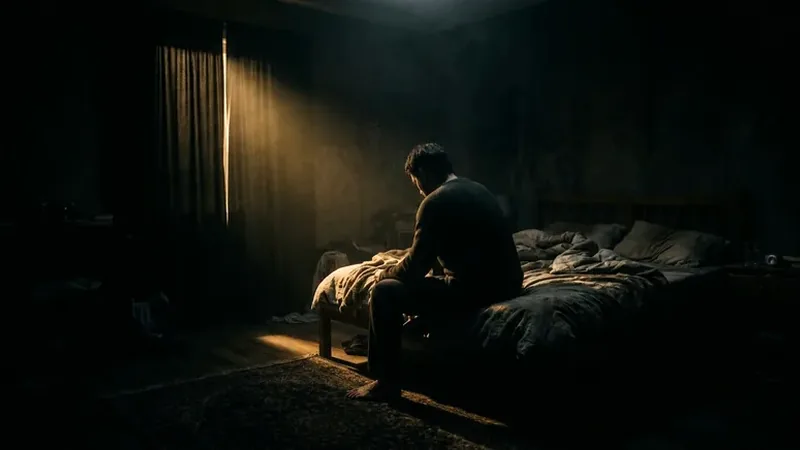
You can wake with anxiety because the body does not wait for a conscious worry before it prepares for threat. The transition from sleep to waking changes autonomic activity, hormones, heart rate, breathing, attention, and bodily awareness. At the same time, the nervous system predicts what morning usually means: work, messages, pain, conflict, responsibility, exposure, or another day of trying to hold everything together.
If those mornings have repeatedly carried fear, the context of morning itself can become a trigger.
The alarm tone, the light through the curtains, the first rise in heart rate, the recognition that it is a weekday, or the thought of opening the phone may activate the old program before the sentence I am anxious appears.
The first thought may be the explanation. It does not have to be the ignition.
Key takeaways
- Waking is a biological transition, not a neutral instant.
- Morning cortisol is real, but the popular “you wake, then cortisol suddenly spikes and causes anxiety” story is too simple.
- Anticipated demand can alter the morning stress response before the day’s event occurs.
- Workdays and weekends can produce different morning patterns in people carrying chronic worry or overload.
- One short or disrupted night can make next-morning anxiety louder.
- Normal waking sensations can become threat cues when attention interprets them as danger.
- Morning anxiety is a pattern, not a diagnosis; new or severe physical symptoms still require medical evaluation.
- The Efremov Method works with the exact reaction that exists now and tests the same morning cue again; it does not require recovering a childhood scene.
The day has not started. The body’s prediction has.
A common morning looks like this:
You wake before the alarm or at the first sound of it.
There is a drop in the stomach.
The chest is tight. The heart is already noticeable. The jaw is braced. The mind has not yet produced a clear problem, but the body feels as if a problem is standing in the room.
Then the explanations arrive.
What do I have today? Did I forget something? What if the symptoms are back? What did that message mean? How am I going to get through this?
Because the thoughts are visible, they receive the blame. It seems that the mind created the anxiety by thinking.
Sometimes it did contribute. But often the order is reversed.
The body changed first. Consciousness received the change and began searching for a reason.
That order matters. It explains why arguing with the thoughts at 6:12 a.m. can feel useless. You are trying to persuade the narration while the alarm is already active underneath it.
The question is not only:
What am I thinking about?
It is also:
What changed in the first second after waking—before I had a sentence?
That first second is where morning anxiety becomes readable.
Waking is a physiological transition, not an empty moment
Sleep and waking are not two rooms separated by a clean door. The body moves between them through a coordinated transition.
Heart rate changes. Blood pressure changes. Breathing changes. Temperature regulation shifts. Attention begins taking in the outside world. Autonomic balance moves away from the physiology of sleep and toward the demands of waking behavior.
In laboratory studies of sleep-to-wake transitions, morning awakening has been associated with a particularly strong shift toward sympathetic activation—the branch of the autonomic nervous system that prepares the body to mobilize.[1]
That does not mean waking is pathological. It means waking is active.
A healthy nervous system uses that activation to stand, orient, move, think, and begin the day. But a threat-trained system can read the same activation differently.
A faster heart can be read as readiness.
Or it can be read as danger.
A breath that changes as the body wakes can be ignored.
Or it can become the first evidence that something is wrong again.
A small internal shift can therefore become a key. The sensation does not need to be extreme. It only needs to resemble a state the system has previously associated with threat.
The body can wake normally—and the old network can misread normal waking as the beginning of danger.
The cortisol story is real—and usually told badly
Morning-anxiety explanations often collapse into one sentence:
It is just cortisol.
That sentence sounds scientific and explains too much.
Cortisol follows a strong daily rhythm. In many people, measurements taken after waking show a marked rise over the first part of the morning. Researchers call this the cortisol awakening response, or CAR, and an expert consensus has standardized how it should be measured and interpreted.[2]
But several facts matter.
First, cortisol is not an anxiety molecule. It is a broad metabolic and regulatory hormone involved in waking, energy availability, immune regulation, blood pressure, and adaptation to demand.
Second, the morning pattern varies greatly between people and within the same person from day to day.
Third, a 2025 study using automated ambulatory microdialysis measured cortisol continuously before and after waking in more than two hundred healthy participants. It did not find evidence that awakening itself consistently increased the rate of cortisol secretion. Much of the familiar rise may already be underway before the person wakes, as part of circadian timing.[3]
This does not make the older CAR literature false. It changes the question.
The honest statement is not:
You woke, cortisol spiked, and that caused your anxiety.
It is:
Morning is a circadian and behavioral transition in which cortisol changes, autonomic activation changes, and anticipated demand can alter the pattern. Anxiety may interact with that system; one hormone does not explain the whole event.
This distinction is important because “it is cortisol” can become another dead end. The person starts hunting supplements, timing tricks, and single blood values while the exact learned trigger remains untouched.
Your body can prepare for a day before your mind names it
The nervous system is predictive.
It does not wait until the meeting begins to prepare for the meeting. It does not wait until the inbox opens to prepare for what the inbox has meant for the last five years.
Researchers have tested this directly.
In one experiment, healthy adults were told that the next day would contain either ordinary activities or an anticipated demanding event. The anticipated-demand condition produced a larger cortisol awakening response even though subjective and objective sleep measures did not explain the difference.[4]
Other daily-life work has linked next-day expectations and anticipated demands with changes in the morning cortisol pattern.[5]
The event was not yet happening.
The body was responding to what the coming day meant.
This is familiar outside the laboratory.
On vacation, a person opens their eyes and lies still.
On Monday, the same person opens their eyes and the stomach contracts before the first conscious thought.
The bed is the same. The body is the same. The sunrise is the same.
The predicted day is not.
The nervous system does not wake into an empty morning. It wakes into a model of what morning has come to predict.
That model can include:
- a job where every mistake feels exposed;
- a partner whose silence predicts punishment;
- a school day associated with humiliation;
- chronic pain expected to return on standing;
- caregiving duties that never end;
- a medical portal that may contain bad news;
- financial pressure waiting on the phone;
- the fear of another panic attack;
- the fear of feeling exactly what is already being felt.
The conscious story can be absent. The prediction is still active.
Why weekdays can feel worse than weekends
One of the clearest clues that morning anxiety is not “random chemistry” is the calendar.
Some people wake anxious from Monday through Friday and considerably calmer on Saturday. Others improve on vacation and relapse on the first morning home. Some feel well until they remember what day it is.
A study of 219 working adults found that perceived work overload and chronic worrying predicted differences between weekday and weekend cortisol awakening patterns. The stronger weekday rise appeared particularly in people carrying chronic work stress and worry; the same relationship was not present in the same way on weekends.[6]
The finding does not prove that every anxious Monday is caused by work. It shows something more useful:
The morning stress response can be context-sensitive.
“Morning” is not only a time on a clock.
It is a package:
- weekday or weekend;
- alarm or natural waking;
- home or hotel;
- alone or beside someone;
- immediately checking the phone or not;
- pain expected or not;
- an authority figure waiting or not;
- a commute, school, caregiving task, or medical appointment ahead.
The system can learn the whole package.
That is why a generic instruction such as have a calm morning routine may help around the edges but fail at the center. It can make the context more comfortable without removing what the context predicts.
One short night can make the morning louder
Morning anxiety is not only about what the day predicts. It is also about the condition of the system doing the predicting.
Sleep loss changes that system.
Naturalistic research has found that sleeping less than one’s own usual amount predicts greater anxiety the following day, with the association especially evident in the morning and afternoon.[7]
Experimental sleep-deprivation work has shown a next-day increase in anxiety together with reduced activity and connectivity in medial prefrontal regions that normally help regulate emotional responses.[8]
A separate naturalistic study found that partial sleep deprivation predicted greater next-day anxious arousal.[9]
None of this means that every bad night creates an anxiety disorder.
It means that sleep loss changes the balance of the system:
- the body is more activated;
- threat cues capture attention more easily;
- regulatory control is weaker;
- normal sensations feel louder;
- uncertainty is harder to tolerate;
- old predictions win faster.
This can create a brutal loop.
Morning anxiety makes the person fear the coming night.
Fear of the night disrupts sleep.
Poor sleep amplifies the next morning.
The next morning now seems to prove that the problem is getting worse.
The loop is real. The conclusion therefore I am broken is not required.
The first body signal can become the trigger
Suppose the original pattern began during a period of genuine overload.
For months, the person woke with a racing heart because life was dangerous, unstable, or unmanageable.
Eventually the external crisis ended.
But now the first noticeable heartbeat after waking has acquired meaning.
It predicts:
Here it comes again.
The heartbeat becomes a trigger for the network that once responded to the crisis. The body notices itself, interprets the sensation through the old rule, and produces more activation. More activation produces a stronger sensation. The stronger sensation appears to confirm danger.
This is an interoceptive loop: a body signal becomes both the object of attention and the evidence used to justify the alarm.
A 2024 meta-analysis of 71 studies found that anxiety is reliably associated with more negative evaluation, greater attention, and greater sensitivity toward internal bodily signals. The relationship with objective interoceptive accuracy was not a simple universal one; the most consistent problem was not that anxious people perfectly detect the body, but that the detected signals are given a more threatening meaning.[10]
That distinction explains morning experiences such as:
- noticing the heart and deciding it is too fast;
- noticing a hollow stomach and calling it dread;
- noticing breath depth and checking it repeatedly;
- noticing light-headedness on standing and preparing for catastrophe;
- noticing warmth and assuming adrenaline is surging;
- noticing fatigue and concluding the day is already impossible.
The sensation is real.
The interpretation may be old.
The body is not lying. The active program can still be wrong about what the body means.
Morning is a context
Behavioral neuroscience often treats context as the background that determines which learned meaning becomes active.
In real life, context is larger than a room.
Morning context can include:
External cues
- the alarm sound;
- a particular ringtone;
- light through one set of curtains;
- the bedroom ceiling;
- footsteps in the hallway;
- the smell of coffee;
- the work laptop on the chair;
- the first notification.
Internal cues
- heart-rate acceleration;
- dry mouth;
- a full bladder;
- muscle stiffness;
- hunger;
- reflux;
- dizziness on standing;
- the first breath taken consciously;
- the remains of a dream.
Predictive cues
- remembering that it is Monday;
- knowing someone expects an answer;
- anticipating pain when getting out of bed;
- expecting conflict;
- expecting another anxious morning;
- expecting not to cope.
A person often says:
I wake anxious for no reason.
A more precise translation is:
The reason has not yet become a sentence.
The system may be reacting to time, body state, context, or prediction before consciousness has assembled a story.
Why morning anxiety is not universal
It is important not to turn one pattern into a law.
Some people are most anxious in the morning. Others worsen late in the day. Chronotype matters: recent work found that daily anxiety patterns differed according to whether a person was more morning-oriented or evening-oriented, with evening types showing more evening anxiety in that sample.[11]
This matters because a universal story—anxiety is always worst in the morning because cortisol is highest—can make people distrust their own data.
Your pattern is the evidence to begin with.
Ask:
- Is it immediate or delayed by ten minutes?
- Is it present before opening the phone?
- Is it different on weekends?
- Is it different away from home?
- Does it begin with a thought or a sensation?
- Does standing up change it?
- Does eating change it?
- Does it track sleep duration?
- Does a specific person, task, or message appear first?
- Is the fear about the day—or about the bodily state itself?
The exact sequence is more useful than a generic label.
Do not diagnose the whole morning as “anxiety”
A racing heart, sweating, tremor, chest pressure, nausea, breathlessness, weakness, or dizziness can occur in anxiety.
They can also occur in medical conditions.
Potential contributors include arrhythmia, thyroid disease, blood-glucose problems, anemia, infection, medication effects, stimulant or alcohol use, withdrawal, sleep apnea, pregnancy or postpartum changes, pain, autonomic disorders, and other causes.
The existence of a nervous-system mechanism does not make every morning symptom psychological.
New chest pain, fainting, severe shortness of breath, sustained irregular heartbeat, new neurological symptoms, significant weakness, or a rapidly changing pattern requires appropriate medical assessment.
The useful question is not:
Is this physical or psychological?
It is:
What is the complete pattern, what must be medically excluded, and what portion remains linked to a repeatable threat response?
What usually keeps the pattern alive
People understandably try to make the morning stop.
They check the pulse.
They search symptoms.
They stay in bed waiting to feel safe enough to stand.
They ask a partner whether everything is okay.
They check the calendar repeatedly.
They open messages before the body has settled—or avoid the phone for hours while imagining what is there.
They repeat affirmations, breathe in a prescribed rhythm, or mentally rehearse the whole day.
Some of these actions provide relief.
Relief can become a safety signal.
Then the nervous system learns a second rule:
The morning was dangerous, but I survived because I checked, delayed, reassured myself, or performed the ritual correctly.
The ritual is now required again tomorrow.
The relief is real.
The generator remains.
This is why the target cannot be “feeling better in the morning” in general. The target must be the exact first cue and exact first charge.
How to identify the exact morning trigger
Do not begin with the whole category morning anxiety.
Slow the first minute down.
1. Find the first frame
What is the earliest moment you can identify?
- before the eyes open;
- at the alarm;
- at the first recognition of the day;
- at the first heartbeat you notice;
- when you remember work;
- when you reach for the phone;
- when you sit up;
- when you see the room;
- when you anticipate the symptom.
2. Find the first body change
Before the explanations, what changes?
- abdomen drops;
- chest contracts;
- breath pauses;
- heat rises;
- vision narrows;
- jaw tightens;
- limbs become heavy;
- urge to check appears;
- urge to hide appears;
- mind goes blank.
3. Separate the first reaction from everything added afterward
After the first charge, secondary networks can pile on:
- fear that the anxiety will last all day;
- shame about still having it;
- anger at the body;
- despair about treatment;
- urgency to find a cause;
- fear of disease;
- fear of failing at work.
Those may all need attention. They are not necessarily the first generator.
4. Identify the exact prediction
Complete the sentence:
This morning state means…
The answer may be:
- I will not cope;
- something bad is already happening;
- I am trapped in another day;
- I will be judged;
- the pain will return;
- I will lose control;
- I will discover bad news;
- I cannot escape what is expected of me.
The prediction may be verbal. It may also exist only as a body certainty.
Where the Efremov Method stands
Independent research supports several parts of the picture:
- waking involves coordinated autonomic and endocrine change;
- anticipated demand can alter morning biological responses;
- sleep loss can increase next-day anxiety;
- attention and interpretation of bodily signals matter;
- daily context and chronic worry can change morning patterns.
Those studies examined other procedures rather than evaluating this specific educational method.
The method makes a separate operational claim.
It does not require the person to reconstruct the first morning this ever happened, recover a childhood event, enter hypnosis, or produce a persuasive explanation.
It begins with the reaction that exists now.
The sequence is direct:
- identify the exact morning cue;
- identify the first bodily and emotional shift;
- work with the active fear charge;
- present the same cue again;
- verify whether the old reaction still launches or remains at zero charge.
The morning provides the context. The first cue provides the address. The same cue provides the test.
Suppose the trigger is the alarm sound.
Before the work, the sound produces a stomach drop, breath interruption, and an immediate image of the workday.
Feeling calm later over breakfast is not the test.
Use the same alarm sound again, carefully and without turning the process into a ritual.
Does the stomach drop?
Does the breath stop?
Does the catastrophic day appear automatically?
Does the body prepare to escape?
If the selected charge still starts, the generator is still active.
If the same cue produces zero charge, the result is observable where the reaction used to begin.
No recovered origin is required.
Your past can remain unknown and private. The result cannot hide.
What science proves—and what remains to be tested
The evidence does not prove that every case of morning anxiety is a learned fear network.
It does not prove that cortisol is irrelevant.
It does not prove that a single psychological procedure will normalize every hormone, heart-rate pattern, or sleep disturbance.
It does support a narrower and important conclusion:
The body can prepare for anticipated demand before the event begins, and the conscious story does not have to be the first step in the response.
The Efremov Method goes further by claiming that the selected current charge can be brought to zero and verified against the same trigger.
Consistent effects on cortisol awakening patterns, heart-rate variability, sleep architecture, or disease outcomes remain separate research questions requiring direct study.
That boundary does not weaken the method.
It tells us exactly what the next experiment should measure.
Frequently asked questions
Because the waking transition and a learned threat response can begin before a clear conscious thought. Autonomic activity, circadian signals, bodily sensations, and predictions about the coming day may already be active. Consciousness then notices the state and starts explaining it.
Cortisol is part of morning physiology, but it is not a complete explanation. The cortisol awakening response varies widely, anticipated demand can influence it, and continuous measurements suggest that much of the rise may begin before waking rather than being caused by awakening itself. Anxiety, sleep, circadian timing, and learned context can all interact.
The nervous system can distinguish contexts. Workday cues may predict evaluation, overload, conflict, commuting, responsibility, or lack of control. Research has found weekday–weekend differences in morning cortisol patterns associated with chronic work overload and worry.
Poor or shortened sleep can increase next-day anxious arousal and weaken prefrontal regulation of threat responses. It can make normal bodily sensations louder and old fear predictions easier to retrieve. Persistent sleep problems also deserve their own medical and behavioral assessment.
A racing or noticeable heart can occur during normal waking activation and anxiety, but it can also have medical causes. A new, sustained, irregular, painful, or faintness-associated pattern requires medical evaluation. When the same morning cue reliably launches the same response after medical causes are addressed, a learned threat loop may be contributing.
It identifies the exact cue and first reaction—such as the alarm sound, opening the eyes, noticing the heart, remembering the day, or reaching for the phone. After working with the active fear charge, the same cue is presented again. The selected reaction either still launches or remains at zero. No trauma narration, regression, trance, or recovered first event is required.
References
- Boudreau P, Yeh WH, Dumont GA, Boivin DB. A circadian rhythm in heart rate variability contributes to the increased cardiac sympathovagal response to awakening in the morning. Chronobiology International. 2012. https://doi.org/10.3109/07420528.2012.674592
- Stalder T, Kirschbaum C, Kudielka BM, et al. Assessment of the cortisol awakening response: Expert consensus guidelines. Psychoneuroendocrinology. 2016;63:414–432. https://doi.org/10.1016/j.psyneuen.2015.10.010
- Klaas M, et al. Awakening not associated with an increased rate of cortisol secretion. Proceedings of the Royal Society B. 2025;292:20241844. https://doi.org/10.1098/rspb.2024.1844
- Elder GJ, Wetherell MA, Barclay NL, Ellis JG. Anticipated next-day demand affects the magnitude of the cortisol awakening response, but not subjective or objective sleep. Journal of Sleep Research. 2018;27(1):47–55. https://doi.org/10.1111/jsr.12569
- Powell DJH, Schlotz W. Daily life stress and the cortisol awakening response: Testing the anticipation hypothesis. PLoS ONE. 2012;7(12):e52067. https://doi.org/10.1371/journal.pone.0052067
- Schlotz W, Hellhammer J, Schulz P, Stone AA. Perceived work overload and chronic worrying predict weekend–weekday differences in the cortisol awakening response. Psychosomatic Medicine. 2004;66(2):207–214. https://doi.org/10.1097/01.psy.0000116715.78238.56
- Cox RC, Sterba SK, Cole DA, Upender RP, Olatunji BO. Time of day effects on the relationship between daily sleep and anxiety: An ecological momentary assessment approach. Behaviour Research and Therapy. 2018;111:44–51. https://doi.org/10.1016/j.brat.2018.09.008
- Ben Simon E, Rossi A, Harvey AG, Walker MP. Overanxious and underslept. Nature Human Behaviour. 2020;4:100–110. https://doi.org/10.1038/s41562-019-0754-8
- Bean CA, Ciesla JA. Naturalistic partial sleep deprivation and next-day anxious arousal. Behavior Therapy. 2021;52(4):861–873. https://doi.org/10.1016/j.beth.2020.10.008
- Clemente S, et al. Interoception and anxiety: A systematic review and meta-analysis of 71 studies. Neuroscience & Biobehavioral Reviews. 2024;165:105923. https://doi.org/10.1016/j.neubiorev.2024.105923
- Cox RC, et al. Diurnal variation in anxiety is influenced by chronotype. Psychiatry Research. 2024;339:116006. https://doi.org/10.1016/j.psychres.2024.116006
- LeDoux JE. Coming to terms with fear. Proceedings of the National Academy of Sciences. 2014;111(8):2871–2878. https://doi.org/10.1073/pnas.1400335111
Does the morning still launch the same reaction before you have even had your first thought?
Work With Me →Scope note: This article is educational. The Efremov Method® is a conscious, self-applicable skill; it does not diagnose, prescribe, or replace medical care. New, severe, recurrent, or unexplained symptoms and medication decisions require appropriate licensed evaluation.