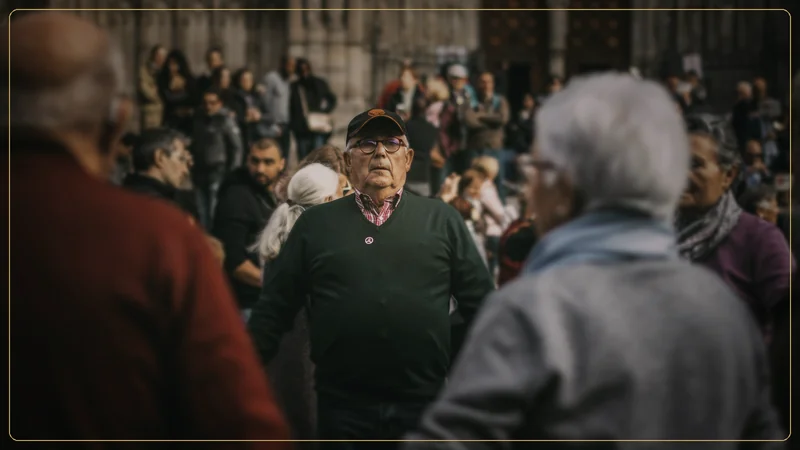
Fight, flight, freeze, and fawn are four ways a threat system can organize action. Fight moves toward the threat. Flight creates distance. Freeze interrupts movement while the nervous system scans and prepares. Fawn tries to reduce interpersonal danger through agreement, appeasement, usefulness, or emotional caretaking. They are not four personality types. They are four possible outputs of fear—and one person can move through all four.
Key takeaways
- Fight, flight, freeze, and fawn are strategies, not identities.
- The strategy can launch before conscious thought and change as the threat gets closer.
- Fight is not the opposite of fear. It is fear moving forward with force.
- Freeze is active preparation, not laziness; shutdown is a deeper defensive state.
- Fawn is people-pleasing used as protection: “If I manage you, you may not hurt or leave me.”
- The Efremov Method works with the exact reaction happening now and checks the same trigger again.
A manager says, “Come into my office.”
One employee straightens, hardens, and begins rehearsing an argument. Another suddenly needs the bathroom and starts looking for a way out. A third stands up—and discovers that the legs will not move. A fourth smiles, apologizes before hearing the complaint, and offers to fix three things nobody asked them to fix.
Four people heard the same sentence. Four bodies prepared four different ways to survive it.
The surface behaviors look unrelated: anger, avoidance, blankness, helpfulness. Underneath them sits one question:
That is the architecture behind fight, flight, freeze, and fawn.
One alarm, four strategies
Popular psychology often presents the four responses as if every person belongs to one permanent type. The nervous system is more flexible than that. It does not assign you a badge marked fighter or freezer. It selects an output from the options it learned were available.
Move toward
Create safety through force, control, anger, argument, intimidation, certainty, or taking command.
Move away
Create safety through escape, avoidance, speed, distance, distraction, overwork, or staying too busy to be reached.
Stop and assess
Create safety through stillness, silence, reduced movement, intense scanning, and withholding action until the system finds an opening.
Make the other safe
Create safety through pleasing, agreeing, apologizing, flattering, helping, soothing, or abandoning your own position.
In Fear Primacy Theory, these are different costumes worn by the same engine. Fight is fear moving forward. Flight is fear creating distance. Freeze is fear holding the body while it calculates. Fawn is fear attempting to regulate the person who appears to control safety.[14]
The output changes. The fear underneath it does not.
The body chooses before the biography speaks
Threat responses are organized in old, fast systems. Joseph LeDoux and Daniel Pine distinguish defensive survival circuitry from the conscious feeling and explanation a person later calls fear or anxiety.[1] The defensive system prepares action; consciousness describes what the preparation feels like.
That order is why a person can already be arguing, backing away, smiling, or unable to speak before they know what frightened them.
Michael Fanselow's threat-imminence model showed that defensive behavior changes with the organism's relationship to danger.[2] Before a threat is detected, the system explores. Once danger is detected but has not struck, movement may stop and attention intensifies. When contact feels imminent, the system shifts toward rapid escape or attack.
Human neuroimaging supports this shift. When an experimental threat was farther away, prefrontal regions involved in evaluation were more engaged. As the threat approached, activity shifted toward midbrain regions, including the periaqueductal gray, that organize rapid defensive action.[3]
The closer danger feels, the less the system behaves like a committee and the more it behaves like an emergency.
Fight: fear with its face turned outward
The fight response is easy to mistake for confidence because it points forward. The voice becomes firmer. The body expands. The jaw sets. The person interrupts, controls the terms, finds fault, raises the stakes, or becomes suddenly certain that only one interpretation is possible.
But anger does not appear in a vacuum. Something valued has been threatened: status, control, belonging, dignity, territory, a loved person, a plan, an identity. The system converts the vulnerable position—I may lose, be exposed, be overpowered, be abandoned—into an active one: I will overpower first.
Modern fight can look like:
- raising the voice or cutting the other person off;
- turning every disagreement into a trial that must be won;
- micromanaging because uncertainty feels intolerable;
- criticizing before someone else can criticize you;
- becoming cold, contemptuous, or relentlessly logical;
- attacking yourself internally before the outside world gets the chance.
Fight can be necessary. If someone is attacking you, forceful action may be the correct response. The structural question is whether the intensity belongs to the present event or to an older network that has mistaken disagreement for annihilation.
Fight is not proof that fear is absent. It is often proof that fear found armor.
Flight: distance as medicine
Flight creates safety by increasing distance. Sometimes that distance is literal: leave the room, end the call, cancel the appointment, drive away. Often it is disguised as ordinary life.
Modern flight can look like:
- checking the phone the moment a conversation becomes intimate;
- staying constantly busy so no difficult feeling catches up;
- researching indefinitely instead of making the decision;
- changing jobs, partners, cities, or projects whenever vulnerability appears;
- over-preparing because spontaneity feels dangerous;
- arriving late, forgetting, becoming unreachable, or finding a sudden reason not to go.
Procrastination can be a flight response when delay creates temporary distance from evaluation, failure, conflict, or exposure. Perfectionism can be flight when endless correction prevents the work from entering the world. Even intellectual analysis can become flight when the person travels farther and farther into explanation while never touching the live reaction.
The test is not whether the behavior involves motion. The test is what the behavior buys: distance from which danger?
Freeze: the body stops so the system can see
Freeze is commonly described as doing nothing. Biologically, it is a highly organized state. The body reduces overt movement while attention sharpens and action is prepared. It is the pause between detection and decision.
In a human social-threat experiment, Karin Roelofs, Muriel Hagenaars, and John Stins found a freezing-like response marked by reduced body sway and heart-rate deceleration when participants viewed angry faces.[4] The person looked still; the system was not idle.
Roelofs later summarized freeze as “freeze for action”: a state that combines parasympathetic heart-rate slowing with motor preparation and heightened perception.[5]
Freeze can feel like:
- the mind going blank in the middle of a sentence;
- words returning only after the confrontation is over;
- knowing exactly what to do while the body will not begin;
- staring at a message for an hour without replying;
- feeling time slow while every detail becomes unusually sharp;
- becoming quiet, small, still, and difficult to notice.
A child who could neither defeat an adult nor leave the house may learn that immobility reduces danger. Decades later, a manager's disapproval can open the same strategy. The adult calls it weakness, laziness, indecision, or “losing my voice.” The network calls it the move that once worked.
Freeze, tonic immobility, and shutdown are not the same state
The words are often blended together, but the distinction is useful.
| State | What the system is doing | Typical experience |
|---|---|---|
| Freeze | Pausing overt movement while scanning, orienting, and preparing action. | Still but alert; heart may slow; attention narrows; muscles remain ready. |
| Tonic immobility | Entering involuntary immobility when escape and active defense feel unavailable. | Unable to move or call out; numbness, reduced pain, detachment, or a sense of being trapped inside the body. |
| Collapse / faint | A different physiological event involving loss of postural tone or consciousness. | Weakness, tunnel vision, loss of balance, or fainting; medical causes must be assessed. |
Kasia Kozlowska and colleagues describe a defense cascade that can move from arousal and freeze into fight or flight, then into tonic immobility and collapsed immobility when the organism experiences inescapable threat.[6] Studies of trauma survivors have also documented biological features of tonic immobility in humans.[7]
This is why shouting “do something” at a frozen person often fails. The command is arriving at the thinking level while the motor system is running a different emergency rule.
Fawn: safety through the other person
Fawn is the newest word in the familiar quartet. Research more often studies the underlying behaviors under names such as affiliation, submission, appeasement, caregiving, and tend-and-befriend. The word fawn is useful because it captures a recognizable moment: the nervous system tries to survive by making the other person pleased, calm, dependent, or unable to justify rejection.
Shelley Taylor and colleagues challenged the idea that stress responses are limited to fight or flight. Their tend-and-befriend model described social affiliation and caregiving as important ways humans seek safety under stress.[8] Fawn overlaps with that social route but has a sharper defensive edge: it is not simply moving toward connection; it is abandoning your position to control the danger in another person's reaction.
Fawn can look like:
- apologizing before anyone says you did something wrong;
- agreeing while the body is saying no;
- studying another person's face instead of noticing your own state;
- becoming indispensable so abandonment feels less likely;
- over-explaining to prevent anger or misunderstanding;
- making yourself smaller, easier, sweeter, quieter, or more useful;
- feeling guilty whenever someone else is disappointed.
Kindness and fawning are not the same. Kindness is available to choice. Fawning feels compulsory. The body has calculated that another person's displeasure is unsafe, so pleasing becomes an emergency action.
The sentence underneath fawn is often simple:
The dedicated article on people-pleasing as a survival strategy follows that response into relationships. Here the important point is structural: fawn belongs in the same family as fight, flight, and freeze because all four are attempts to solve fear through action.
You are not one type
The same nervous system can select different strategies depending on power, distance, escape routes, relationship, fatigue, and prior learning.
You may fight with a partner because closeness makes confrontation possible. You may freeze with a boss because the power difference closes the fight option. You may flee from an email because distance is easy. You may fawn with a parent because appeasement was the oldest route to belonging.
The sequence can also change within one episode:
That is not inconsistency. It is one threat system trying strategy after strategy.
In animal research, shifts between high-fear and low-fear states corresponded to changes in the balance of distinct neuronal populations in the amygdala.[12] Fear is a state of a working circuit, not a permanent essence of the person.
How to identify the response that actually launches
Do not begin with the label. Begin with the first observable change.
Then ask one sharper question: What danger would this action prevent?
Fight may prevent humiliation. Flight may prevent evaluation. Freeze may prevent a wrong move. Fawn may prevent rejection. The visible behavior is the strategy; the feared consequence is the engine.
This is where Fear Primacy Theory simplifies what otherwise looks like four separate problems. The behaviors differ, but each can be traced to the threat it is trying to neutralize.[14]
Why naming the response is not enough
Recognizing “I am freezing” can stop self-blame and help restore perspective. But a label is not the same as changing the network.
A person can become fluent in trauma language and still go blank in every conflict. They can know they fawn and continue apologizing before every difficult conversation. They can explain their flight response perfectly while canceling the next opportunity. Understanding describes the pattern. The trigger still tests whether the pattern remains.
Breathing, grounding, movement, medication, reassurance, and practicing a new behavior can reduce the current wave. That can be valuable. The deeper question is what happens when the same cue returns without preparation.
Management begins after the response launches. Structural work changes whether the response launches.
How the Efremov Method works with fight, flight, freeze, and fawn
The method does not work on “my nervous system” as one vague object. It selects one exact reaction.
For example:
- “When he raises one eyebrow, heat rises into my face and I begin proving him wrong.”
- “When I see the unread message, my chest tightens and I close the app.”
- “When she asks what I want, my mind goes blank and I cannot speak.”
- “When someone sounds disappointed, I apologize and offer more than I can give.”
Each sentence contains a cue, a live reaction, and an action strategy. That is enough to begin. The person does not need to recover the first event, tell the trauma story, enter trance, or rebuild a biography. The reaction that exists now is the access point. The past can remain unknown and private.
The method's sequence: identify the exact cue, select the exact fear response, remove its charge, and present the same cue again. The old fight, flight, freeze, or fawn response either launches—or it produces zero charge.[15]
The goal is not to make a person passive. Removing pathological fight leaves the ability to defend. Removing pathological flight leaves the ability to leave real danger. Removing freeze leaves the ability to pause deliberately. Removing fawn leaves kindness without compulsion.
Healthy protection stays. The old command ends.
Defensive behavior changes with threat proximity; human freezing is measurable; conscious explanation and automatic defensive circuitry are not the same process.
Fight, flight, freeze, and social appeasement are different outputs selected by a threat system attempting to create safety.
The reaction that exists now is the access point. No recovered origin, trance, or trauma narration is required.
Present the same cue again. The old response either launches, or it produces zero charge. The result cannot hide in interpretation.
When a “freeze” or “collapse” needs medical assessment
Sudden fainting, a seizure, new weakness or numbness, chest pain, severe shortness of breath, an irregular sustained heartbeat, loss of consciousness, or progressive neurological symptoms require medical assessment. A defensive response can feel dramatic, but a psychological label should never be used to skip immediate physical danger.
Once urgent causes are addressed, the structural question becomes precise: which cue launches which strategy—and does that strategy still need to run?
Frequently asked questions
References
- LeDoux JE, Pine DS. (2016). Using neuroscience to help understand fear and anxiety: a two-system framework. American Journal of Psychiatry 173:1083–1093. DOI ↩
- Fanselow MS. (1994). Neural organization of the defensive behavior system responsible for fear. Psychonomic Bulletin & Review 1:429–438. DOI ↩
- Mobbs D, Petrovic P, Marchant JL, et al. (2007). When fear is near: threat imminence elicits prefrontal-periaqueductal gray shifts in humans. Science 317:1079–1083. DOI ↩
- Roelofs K, Hagenaars MA, Stins J. (2010). Facing freeze: social threat induces bodily freeze in humans. Psychological Science 21:1575–1581. DOI ↩
- Roelofs K. (2017). Freeze for action: neurobiological mechanisms in animal and human freezing. Philosophical Transactions of the Royal Society B 372:20160206. DOI ↩
- Kozlowska K, Walker P, McLean L, Carrive P. (2015). Fear and the defense cascade: clinical implications and management. Harvard Review of Psychiatry 23:263–287. DOI ↩
- Volchan E, Souza GG, Franklin CM, et al. (2011). Is there tonic immobility in humans? Biological evidence from victims of traumatic stress. Biological Psychology 88:13–19. DOI ↩
- Taylor SE, Klein LC, Lewis BP, et al. (2000). Biobehavioral responses to stress in females: tend-and-befriend, not fight-or-flight. Psychological Review 107:411–429. DOI ↩
- LeDoux JE. (2014). Coming to terms with fear. PNAS 111:2871–2878. DOI
- Li W, Keil A. (2023). Sensing fear: fast and precise threat evaluation in human sensory cortex. Trends in Cognitive Sciences 27:341–352. DOI
- Knight DC, Nguyen HT, Bandettini PA. (2003). Expression of conditional fear with and without awareness. PNAS 100:15280–15283. DOI
- Herry C, Ciocchi S, Senn V, et al. (2008). Switching on and off fear by distinct neuronal circuits. Nature 454:600–606. DOI ↩
- Efremov A. (2024). Psychosomatics: Communication of the Central Nervous System through Connection to Tissues, Organs, and Cells. Clinical Psychopharmacology and Neuroscience 22:565–577. DOI
- Efremov A. (2025). The Fear Primacy Hypothesis in the Structure of Emotional States: A Systematic Literature Review. Psychological Reports. DOI ↩
- Efremov A. (2023). Eliminating Psychosomatic Pain and Negative Emotions with Dehypnosis. Journal of Organizational Behavior Research. DOI ↩
You are not a response type. You are the person the old response has been interrupting.
Work With Me →The Efremov Method® teaches a self-applicable skill. It does not diagnose or prescribe. New or unexplained physical symptoms, medical emergencies, fainting, loss of consciousness, and medication changes require appropriate licensed care.