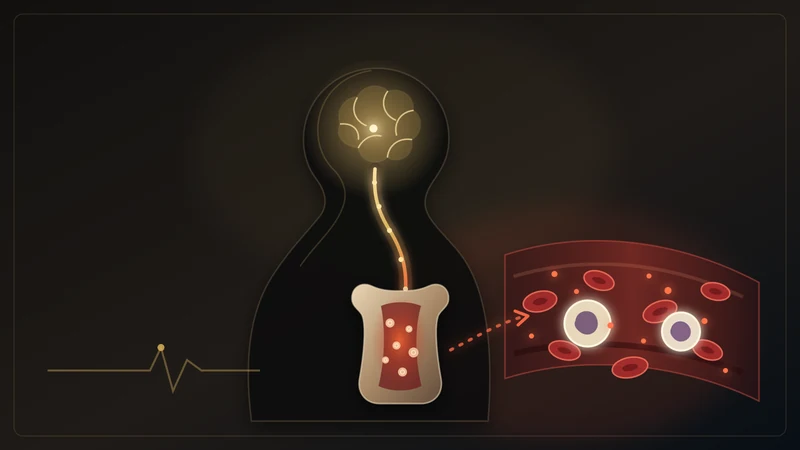
Yes. Chronic psychological stress can increase inflammatory signaling. Sympathetic nerves can change blood-cell production in bone marrow, persistent adversity can shift immune-cell gene expression toward inflammation, and chronic stress can make immune cells less sensitive to cortisol’s restraining signal. CRP is nonspecific, so its source must be interpreted in clinical context—but the stress-to-inflammation pathway itself is measurable.
Key takeaways
- Acute stress is a short alarm. Chronic stress can keep parts of the inflammatory system engaged.
- The strongest evidence is not merely “people felt stressed”: changes have been measured in bone marrow, circulating immune cells, gene expression, cortisol sensitivity, IL-6, and related markers.
- Human and animal studies converge on the same direction: persistent threat changes immune production, signaling, and regulation.
- Fear is not an abstract feeling. When it remains active, it becomes a measurable biological load.
The phrase “stress causes inflammation” names a real biological chain. The nervous system and immune system are physically connected. A threat response does not remain in a thought: it travels through nerves, hormones, bone marrow, and immune cells.
When the response is brief, the system returns toward baseline. When fear remains active, the same protective machinery becomes part of a chronic inflammatory load. That is the mechanism this article follows.
The short pathway: from threat to inflammatory signaling
This is a summary, not a claim that one straight line explains every case. The stress response is a network with feedback in both directions. Inflammation can also reach the brain and alter mood, motivation, sleep, and threat sensitivity. The result can become a loop rather than a one-way arrow.
Evidence 1: chronic stress can change the blood-cell factory
Blood cells are produced in bone marrow. In 2014, Tobias Heidt, Matthias Nahrendorf, and colleagues asked whether chronic stress could reach that factory itself. In mice exposed to chronic variable stress, sympathetic signaling changed the bone-marrow niche, accelerated the proliferation of blood-forming stem and progenitor cells, and increased the output of inflammatory monocytes and neutrophils.[1]
The study also included a human component. Intensive-care medical staff were assessed during lower-strain and higher-strain periods. The higher-strain condition was associated with increased circulating white cells, including the same inflammatory cell classes implicated in the animal work.[1]
The important finding was not simply that stressed people reported feeling worse. The machinery that manufactures immune cells changed its output. The animal work supplied the mechanism; the human data showed that a related blood pattern occurs under real occupational strain.
What this proves: chronic stress can influence hematopoietic activity and inflammatory-cell production. What it does not prove: that stress is the sole cause of any individual person’s inflammation, or that every stressful job produces the same effect.
Evidence 2: adversity can change which immune genes are turned up
Steven Cole and colleagues studied how prolonged social adversity is reflected inside human leukocytes. Across work on loneliness and other forms of sustained threat, they described a recurring pattern later called the conserved transcriptional response to adversity, or CTRA: greater expression of several pro-inflammatory genes alongside lower expression of parts of the antiviral response.[2][3]
This does not mean that a feeling “rewrites your DNA.” The DNA sequence is not replaced. Gene expression changes: the same immune cells alter which instructions they are using more or less intensively.
It also does not mean the CTRA is a clinical blood test that can diagnose hidden fear in an individual. It is a research framework describing group-level transcriptional patterns associated with sustained adversity.
Evidence 3: the cortisol brake can become less effective
Cortisol is often described as a stress hormone, but it also helps restrain inflammation. That creates an obvious question: if stress raises cortisol, why would stress increase inflammation?
One answer is glucocorticoid resistance. Under prolonged stress, immune cells can become less responsive to cortisol’s anti-inflammatory signal. The brake is being pressed, but the system answers less effectively. Studies by Gregory Miller, Sheldon Cohen, and colleagues linked chronic psychological stress with reduced glucocorticoid sensitivity and less controlled inflammatory responses.[4][5]
This is one component of what Bruce McEwen called allostatic load: the accumulated biological cost of repeatedly activating systems designed for short emergencies.[6]
Evidence 4: long-term caregiving stress tracked with faster IL-6 increase
A six-year study compared people caring for a spouse with dementia with matched controls. Both groups showed age-related increases in interleukin-6, an inflammatory cytokine. The increase was roughly four times faster in the caregiver group.[7]
That result is striking because it followed people over time rather than taking one snapshot. It is still observational: caregiving includes disrupted sleep, changes in activity, social isolation, and many other exposures. The study supports a connection between prolonged caregiving strain and faster inflammatory aging; it does not isolate one emotion as the only cause.
Can stress raise CRP?
It can contribute to biology associated with higher C-reactive protein, but the answer requires precision. CRP is made by the liver in response to inflammatory signaling, especially IL-6. High-sensitivity CRP, or hs-CRP, can measure lower concentrations used in cardiovascular-risk research. Neither test can tell you why inflammation is present.
A high CRP does not diagnose “stress inflammation.” Infection, recent injury or surgery, inflammatory disease, smoking, body composition, strenuous exercise, medications, hormones, and many other factors can affect the result. One number has to be read in medical context.
When clinicians use hs-CRP, they interpret the value alongside symptoms, history, other tests, medication, and whether the person was acutely ill. A trend obtained under comparable conditions is often more informative than a single isolated result. That is a matter to discuss with a physician—not a diagnosis to make from an article.
How fear becomes inflammation
Chronic psychological stress and adversity alter inflammatory-cell production, immune-gene expression, glucocorticoid sensitivity, and inflammatory markers in humans and animals.
What people call chronic stress can be traced to specific threats: loss, rejection, humiliation, failure, helplessness, physical danger, or collapse of identity.
The live fear response is the access point. The method removes its charge and checks the same trigger again, so the result cannot hide behind an explanation.
Fear Primacy Theory, published in Psychological Reports, makes the vague word stress precise: beneath the pressure is a specific predicted danger—loss, rejection, humiliation, failure, helplessness, physical harm, or threat to identity.[11]
Once the fear is named, the pathway is no longer mysterious. The central nervous system communicates with tissues, organs, and cells through neural, endocrine, immune, and metabolic routes mapped in my published psychosomatics review.[12]
If the arrow can run down, can it run back up?
Yes. The connection is bidirectional. Inflammation can signal back to the brain through humoral, neural, and cellular routes. This is part of the biology of sickness behavior: during infection, inflammatory signals help produce fatigue, social withdrawal, reduced appetite, altered sleep, and lower motivation so that the organism rests.[8]
If inflammatory signaling persists, parts of that protective program can persist as well. This does not mean every low mood is inflammatory, or every inflammation is psychological. It means “mind” and “body” cannot be treated as sealed departments.
Does psychological work change immune markers?
A 2020 systematic review and meta-analysis in JAMA Psychiatry combined 56 randomized clinical trials involving 4,060 participants. Across diverse psychosocial interventions and immune outcomes, assignment to an intervention was associated with an overall 18% reduction in harmful immune-system activity and a 15% increase in beneficial immune function. Effects were detectable for at least six months after treatment.[9]
The measured endpoint was immune function—and it changed. Across 56 randomized trials, structured psychological work was followed by lower harmful immune activity, higher beneficial immune function, and effects that remained detectable for at least six months. The mind-to-immune pathway is not a metaphor; it moves laboratory markers.
What this means for the Efremov Method
The operational starting point is the reaction that exists now. A person does not have to reconstruct a childhood scene, disclose a trauma narrative, enter a trance, or prove where the reaction began. The present emotion, bodily sensation, impulse, pain pattern, state, or trigger is the access point.
The method does not teach a person to calm down beside the same fire. It identifies the specific fear response, removes its charge, and checks the same trigger again. The reaction is tested directly. When a bodily marker matters as well, it can be measured separately: the trigger tests the network; the biomarker tests what changed in the body.
What to do with this information
- Do not use “stress” to dismiss a symptom. A psychologically influenced symptom is still a physical event, and new or concerning symptoms deserve appropriate medical evaluation.
- Do not use a CRP value to diagnose the cause. Inflammatory markers are clues, not verdicts.
- Make the word stress specific. Ask what outcome the system is preparing against: loss, exposure, rejection, failure, conflict, pain, or danger. A vague label becomes a concrete fear response that can be tested.
- Use two direct measurements. Test the fear response against the same trigger, and use an appropriate biomarker when you want to know what changed in the body. One measures the network; the other measures its biological output.
Frequently asked questions
References
- Heidt T, Sager HB, Courties G, et al. (2014). Chronic variable stress activates hematopoietic stem cells. Nature Medicine 20:754–758. DOI ↩
- Cole SW. (2014). Human social genomics. PLOS Genetics 10:e1004601. DOI ↩
- Cole SW, Hawkley LC, Arevalo JM, et al. (2007). Social regulation of gene expression in human leukocytes. Genome Biology 8:R189. DOI ↩
- Cohen S, Janicki-Deverts D, Doyle WJ, et al. (2012). Chronic stress, glucocorticoid receptor resistance, inflammation, and disease risk. PNAS 109:5995–5999. DOI ↩
- Miller GE, Cohen S, Ritchey AK. (2002). Chronic psychological stress and the regulation of pro-inflammatory cytokines: a glucocorticoid-resistance model. Health Psychology 21:531–541. DOI ↩
- McEwen BS. (1998). Protective and damaging effects of stress mediators. New England Journal of Medicine 338:171–179. DOI ↩
- Kiecolt-Glaser JK, Preacher KJ, MacCallum RC, et al. (2003). Chronic stress and age-related increases in the proinflammatory cytokine IL-6. PNAS 100:9090–9095. DOI ↩
- Dantzer R, O’Connor JC, Freund GG, Johnson RW, Kelley KW. (2008). From inflammation to sickness and depression: when the immune system subjugates the brain. Nature Reviews Neuroscience 9:46–56. DOI ↩
- Shields GS, Spahr CM, Slavich GM. (2020). Psychosocial interventions and immune system function: a systematic review and meta-analysis of randomized clinical trials. JAMA Psychiatry 77:1031–1043. DOI ↩
- Furman D, Campisi J, Verdin E, et al. (2019). Chronic inflammation in the etiology of disease across the life span. Nature Medicine 25:1822–1832. DOI
- Efremov A. (2025). The Fear Primacy Hypothesis in the Structure of Emotional States: A Systematic Literature Review. Psychological Reports. DOI ↩
- Efremov A. (2024). Psychosomatics: Communication of the Central Nervous System through Connection to Tissues, Organs, and Cells. Clinical Psychopharmacology and Neuroscience 22:565–577. DOI ↩
Want to examine whether a specific fear-based reaction is adding load in your case?
Work With Me →The Efremov Method® teaches a self-applicable skill. It does not diagnose the source of inflammation or interpret an individual laboratory result. Medical emergencies, abnormal tests, persistent symptoms, and medication changes require appropriate licensed care.